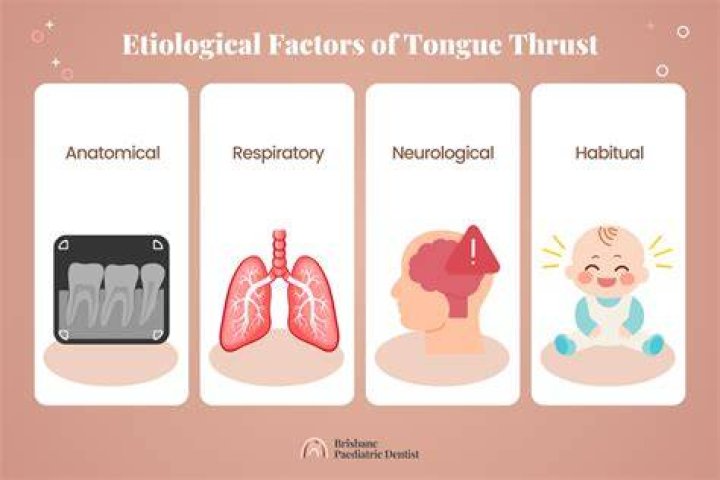
Causes of Tongue Thrust
Tongue thrust is an orofacial myofunctional disorder that typically is caused by thumb-sucking or extended pacifier usage. It also may be due to an untreated tongue-tie. Early diagnosis and treatment through myofunctional therapy corrects the improper tongue movements.How do I stop my tongue thrusting?
How to Stop a Tongue Thrust at Home
- Place a sugar-free lifesaver on the tip of your tongue.
- Press the tip of your tongue against the roof of your mouth, so that it's pushing against the gum just behind your upper front teeth.
- Bite your teeth together in your regular bite, keeping your lips apart.
- Swallow.
Is it normal to have tongue thrust?
Tongue thrust appears when the tongue presses forward too far in the mouth, resulting in an abnormal orthodontic condition called an “open bite.” The condition is most common in children. It has a myriad of causes, including: poor swallowing habits.
Does tongue thrust go away?
In infancy, tongue thrust is a natural reflex that happens when something touches the baby's mouth. This reflex causes the tongue to push out to help the baby breast or bottle-feed. As the child gets older, their swallowing habits naturally change and this reflex goes away.
What causes tongue thrust in adults?
Tongue thrust can occur for a plethora of reasons but develops most often due to frequent sucking of the thumb or fingers, or to compensate for the range of motion caused by a tongue-tie.
TONGUE THRUST SOLUTIONS l Q&A with Dr. Bailey
Can anxiety cause tongue thrusting?
Rubbing and thrusting of the tongue against the teeth occurs as a manifestation of anxiety in the tense, apprehensive, pent-up individual; it occurs par ticularly when the person is subject to emo tional stress.
Why am I pushing my tongue against my teeth?
Symptoms of Tongue Thrust
Tongue thrust affects how you speak, eat, and swallow. Since tongue thrust causes the tongue to push against the back of your front teeth, it could cause misalignment or gaps to appear over time. The gradual movement could require orthodontic treatment to realign your smile.
Can Invisalign fix tongue thrust?
Early intervention can help fix these issues and make future orthodontic treatment with braces and Invisalign easier, but tongue thrusting will remain a concern during the treatment process if it is not addressed.
Where should your tongue rest when sleeping?
Known as “tongue positioning,” there is a right and wrong way. When closing the mouth, the teeth should be slightly apart while the tongue rests on the roof of the mouth but not against the teeth. Not only does this correct form of tongue positioning ensure better oral health, but it also prevents teeth from shifting.
When should tongue thrust be corrected?
The best age to being treatment is 8 years old. Most patients are 8-12 years old. Treatment may be recommended for younger children, ages 4-7, depending on the child's condition.
Is tongue thrust genetic?
Children may be more prone to tongue thrusting due to hereditary factors. Certain types of artificial nipples and prolonged thumb sucking behaviors may also contribute to tongue thrusting.
Why am I pushing my tongue against my teeth at night?
When your tongue is resting at the bottom of your mouth, every time you swallow it is pushing forward against your teeth. Essentially, it's poor muscle coordination, and is a habit that can be fixed. These two problems sometimes go hand in hand, if you have a tongue tie you could also develop a tongue thrust.
Does tongue thrust cause Lisp?
Lisping occurs when the tongue protudes between the teeth when making the "S" sound, resulting in a "th" sound. Tongue thrust is the pushing of the tongue against the teeth while swallowing or at rest. The average person swallows 2000 - 4000 times per day and exerts pressure with each swallow.
Should teeth touch when resting?
The standard resting position has the teeth not touching each other; when the mouth is closed the teeth are slightly apart.
Should your tongue touch your teeth when talking?
You don't want your tongue to press against the backs of your teeth either, as this may cause problems with your teeth alignment over time. “Your tongue should be touching the roof of your mouth when resting,” explains Dr. Ron Baise, dentist of 92 Dental in London.
Can your tongue block your airway when sleeping?
During sleep, for example, your tongue relaxes and falls back. If it's larger than usual, or set higher than normal, it can fully or partially block your airway. This means you'll struggle to breathe when you're asleep, diminishing the quality of your rest and causing a range of other oral health issues.
Will braces fix tongue thrust?
Tongue therapy is usually completed during orthodontic treatment. Generally, the tongue-thrust swallowing pattern may be handled in two ways: Correction by MyoFunctional Therapy or Tongue Therapy, which is an exercise technique that re-educates the tongue muscles.
Can braces help with tongue thrust?
Orthodontics and Tongue Thrust Braces involve correcting misaligned teeth by moving them into their correct position. Night Guards and Tongue Cribs can also help prevent the soreness that results from excessive pressure during excessive nighttime involuntary tongue movement.
Can a night guard help with tongue thrusting?
Those who have a tongue thrust may find that night guard helps to prevent soreness with their teeth. If too much pressure is placed on the teeth during the night by the tongue thrusting and forcing them forward, teeth can move and be sore in general. A guard can help to protect them from this pressure.
Can TMJ cause tongue thrust?
Recent clinical impressions have suggested that tongue-thrust swallowing may often occur in patients with internal derangement of the temporomandibular joint(s) and may represent an unconscious effort to avoid temporomandibular joint (TMJ) dysfunction by minimizing noxious stimuli from the joints.
What is COVID tongue?
What are COVID tongue symptoms? In that same British study by the British Journal of Dermatology, the following symptoms were noted: Lingual papillitis (inflammation of the small bumps on the tongue's surface) Glossitis with indentations (swollen or inflamed tongue) Aphthous ulcers (mouth ulcers)
How can I relax my mouth?
Tilt your head slightly downwards, and open your jaw. Let it hang there for a count of 20 seconds. If you find yourself struggling to relax your jaw, try putting your tongue to the roof of your mouth! You can practice this relaxation technique at your desk, during lunch, or even when you're home before bed.
How do I stop Parafunctional habits?
Limit the parafunctional habits such as teeth grinding and clenching, lip biting, nail biting, chewing gums excessively. Avoid resting hands on chin for a prolonged time. Stress more on soft, cooked and nutritious food. Avoid crunchy, hard, sticky food.
How do you say s without lisp?
If you have difficulty with "S" sounds, try the "Butterfly Technique." Place the outside of your tongue lightly on the sides of your teeth, like the wings of a butterfly. Keep the centre of your tongue curved in a groove letting the air flow over it. Now, try to make an "S" sound.
How can a teen get rid of a lisp?
Techniques to correct lisping
- Awareness of lisping. Some people, especially younger children, may not be able to readily correct their lisp if they aren't aware of their difference in pronunciation. ...
- Tongue placement. ...
- Word assessment. ...
- Practicing words. ...
- Phrases. ...
- Conversation. ...
- Drinking through a straw.